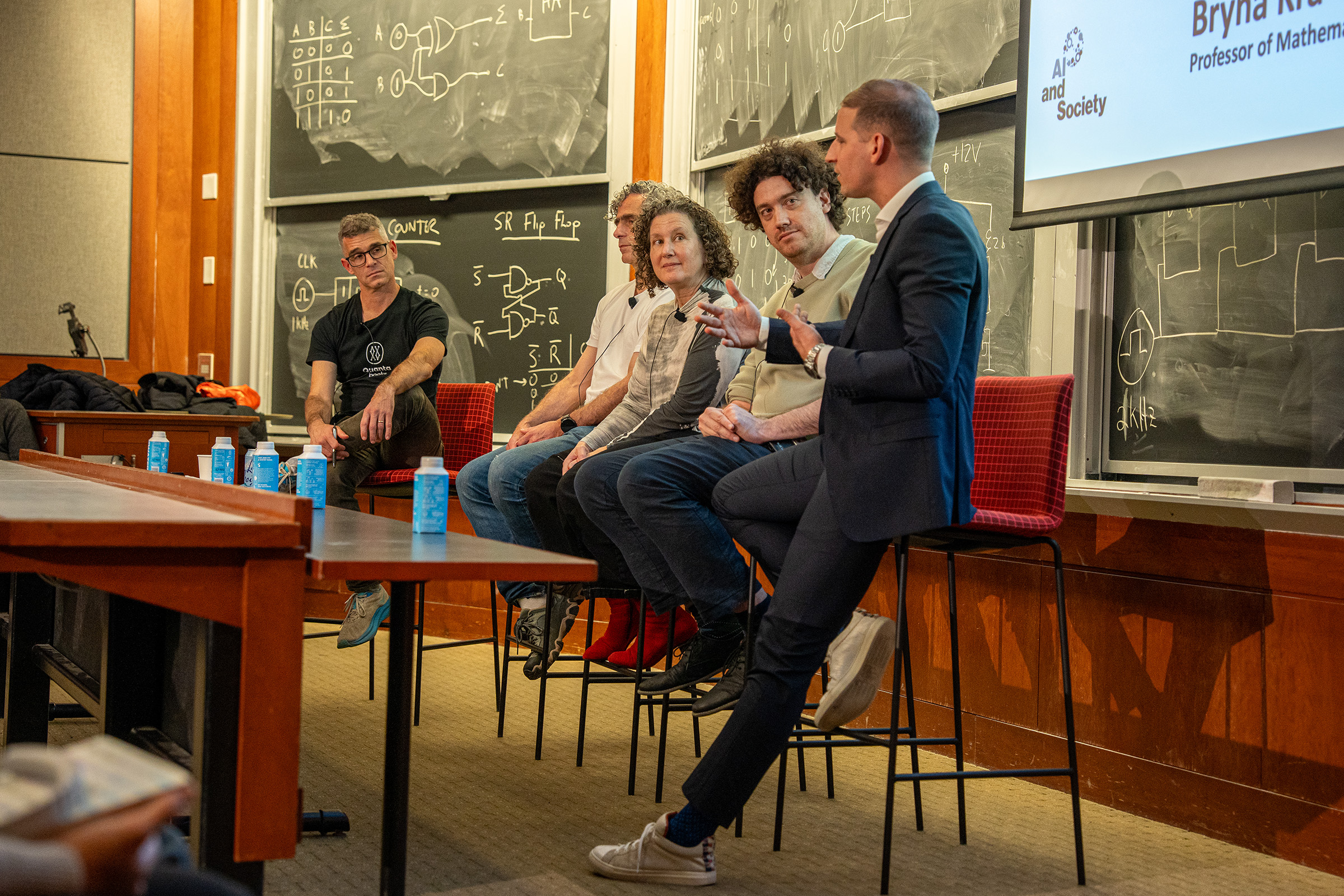
Press Inquiries Press Contact : Abby Abazorius Email: abbya@mit.edu Phone: 617-253-2709 MIT News Office Media Download ↓ Download Image Caption : Kevin Hartnett (far left) moderated the panel discussion with mathematicians Michael Hopkins, Bryna Kra, Tristan Buckmaster, and Jacopo Borga (pictured left to right). Credits : Credit: Hanley Valentin ↓ Download Image Caption : “For math to be important, it has to have human understanding,” Tristan Buckmaster said during the event, which took place in a packed lecture hall in MIT’s Building 3. Credits : Credit: Hanley Valentin *Terms of Use: Images for download on the MIT News office website are made available to non-commercial entities, press and the general public under a Creative Commons Attribution Non-Commercial No Derivatives license . You may not alter the images provided, other than to crop them to size. A credit line must be used when reproducing images; if one is not provided below, credit the images to "MIT."
Close Caption : Kevin Hartnett (far left) moderated the panel discussion with mathematicians Michael Hopkins, Bryna Kra, Tristan Buckmaster, and Jacopo Borga (pictured left to right). Credits : Credit: Hanley Valentin Caption : “For math to be important, it has to have human understanding,” Tristan Buckmaster said during the event, which took place in a packed lecture hall in MIT’s Building 3. Credits : Credit: Hanley Valentin Previous image Next image
It’s been a tumultuous year for math. Big open questions that have occupied mathematicians for decades are now being solved in a matter of hours by artificial intelligence agents that companies deploy by the thousands to work on a single problem in tireless lockstep.
AI’s relentless rise is raising existential questions for the field: How will the tools affect humans’ understanding of mathematical concepts? In the face of AI’s brute-force productivity, will mathematicians still have jobs? And what will all this mean for mathematics as an intellectual pursuit?
At MIT, mathematicians grappled with these and other questions at a panel discussion on Monday titled “AI and Society: The Future of Math.” Leading mathematicians from MIT, Harvard University, Northwestern University, and New York University — each experts in their respective fields — sat down for a conversation that touched on the quality of AI math, how AI is challenging long-established research norms, and the evolving opportunities for mathematicians, whether they embrace the machines or remain “AI vegans.”
The wide-ranging discussion, which took place in a packed lecture hall in MIT’s Building 3, was moderated by science writer Kevin Hartnett, author of “The Proof in the Code,” and featured Jacopo Borga, the Cecil and Ida Green Career Development Assistant Professor of Mathematics at MIT; Michael Hopkins, the George Putnam Professor of Pure and Applied Mathematics at Harvard University; Bryna Kra, the Sarah Rebecca Roland Professor of Mathematics at Northwestern University; and Tristan Buckmaster, professor of mathematics at New York University's Courant Institute of Mathematical Sciences.
As the panelists shared their various and at times conflicting perspectives on AI’s impact, one thing was clear:
“Math has changed more in the last two months than in the last 100 years,” said Kra, who cautioned that AI’s power will change what it is to be a mathematician and what it will take to advance human knowledge in meaningful ways. “It’s like the first sentence in ‘A Tale of Two Cities’: ‘It was the best of times, it was the worst of times.’ It’s a really exciting moment … and also scary.”
Artificial intelligence has made steady strides over the last decade thanks in large part to mathematicians themselves, who out of curiosity have been honing AI models to solve problems with known solutions. These early exercises proved successful, most notably in 2025. That summer, at the International Mathematical Olympiad, Google DeepMind’s AI models achieved gold-medal status by quickly finding solutions to most of the problems that were posed to the world’s best high school mathematicians.
Around that same time, other mathematicians found that some AI systems could solve problems with known solutions, but in ways that were slightly improved compared to the solutions that human mathematicians had derived.
In 2026, AI’s power took a quantum leap. In several instances, scientists found that models could solve open-ended research questions — mathematical problems that had no known answer. Then, in September, OpenAI made a field-shaking announcement: The company focused thousands of its AI agents on a singular challenge, and after 88 hours, the agents produced a proof related to the Navier-Stokes equation — a Millienum Prize Problem that is one of seven unsolvable mathematical Holy Grails.
OpenAI’s sudden interest in the Navier-Stokes challenge coincided with work by Tristan Buckmaster, one of the panelists. After a year of progress, he and his collaborator, at rival AI behemoth Anthropic, were on the cusp of solving the problem when OpenAI made its announcement.
OpenAI’s sprint to be first to the proof opened up a huge debate, about whether proper credit was given, whether the mathematicians’ data was leaked, how the AI agents arrived at their solution, whether that solution makes any meaningful sense, and above all, how AI will change mathematical research.
A month later, the company doubled down, releasing 722 manuscripts, organized into categories that ran the gamut of mathematical topics. The manuscripts claimed to have used AI entirely to solve many of math’s major, unsolved problems — an achievement that has widely been coined the “mathocalypse.”
But many mathematicians insist that it isn’t just about whether a problem can be solved, but also, how. And, they say, when they’ve looked into the details of AI proofs, it’s not clear how the agents arrived at their conclusions.
“The papers themselves are nonsense,” Hopkins said during Monday’s discussion, noting that AI-generated proofs contain “strange ideas.” He continued: “There still is a sense of AI math versus human math.”
For mathematicians like Kra, this moment in math’s history presents an opportunity to let go of certain long-held norms of mathematical research, such as competition among research groups and the prestige of being the first to prove an idea, also known as priority.
“It shouldn’t matter that you’re first,” Kra said. “Speed should not be a priority. It’s not about the proof production anymore. We need to find other ways to assess understanding.”
However, “We can throw away priority, but people are going to want to be pioneers,” Hopkins countered, noting the challenge that mathematicians will now face in making in-roads where AI has already clear-cut.
Kra, however, struck a hopeful counterpoint:
“You can be a pioneer in different ways, for instance in communicating [how a proof came to be],” said Kra, who helped this year to draft the Leiden Declaration on Artificial Intelligence and Mathematics — a statement signed by mathematicians around the world that calls for action to address the risks that AI poses to mathematical research. “Communication of math is even more important now.”
Indeed, the panelists have already seen a subtle shift in what is expected of a mathematician, at all levels, from undergraduate students to early and established career mathematicians.
“The interview is becoming more important,” said Kra, noting that it’s no longer enough to accept, hire, or promote a mathematician based on ideas they have written or published — they have to also show that they understand and can explain those ideas to another person.
AI is also making mathematicians question the role of academic journals, which have long been the benchmark for evaluating and validating mathematical advances.
“Ninety percent of how we’ve judged [mathematicians] are through journals,” says Jacopo Borga, who is an early-career mathematician at MIT. “I’m not sure that’s how we should do this anymore. We should come up with a new metric and let it evolve.”
Kra, who is a managing editor of a specialty journal, is seeing a huge increase in the number of papers submitted, primarily reporting results that were generated or assisted by AI. To deal with the deluge, that particular journal has had to hire an additional managing editor.
Where journal editors have traditionally prioritized publishing new proofs that push the field forward, Kra sees that, in response to AI “slop,” some publications are putting more value on exposition — the section of a paper that explains the reasoning behind a conjecture or proof. For now, humans have the advantage over AI in communicating mathematical ideas.
“There’s a real art to exposition, if you can explain something in a clear and elegant way,” Hopkins echoed.
Kra noted that there are experimental journals coming online now, that are designed to highlight uniquely human contributions to mathematics. For instance, there are journals that publish expositions, such as papers that explain an old result in a new way that modern mathematicians can understand.
“There is a lot of opportunity to curate and translate knowledge,” said Hopkins, who shared that one of his students has been working to prove a theorem from the 1970s. The original language and construction from that decades-old theorem, he said, was just as foreign as some of AI’s proofs today.
In noting novel approaches journals are taking in response to AI, Kra also mentioned Mathematical Discourse , a new peer-reviewed “video journal” that will feature videos of people giving talks about mathematical research. The journal’s preliminary site states that “giving a mathematical talk captures the human side of mathematics in a unique way, and supporting these human aspects of our discipline will be ever more important in the coming years.”
The rise of AI may be hitting especially hard for students, who are still learning the fundamentals in the presence of so many AI shortcuts.
“Mathematics is probably the slowest science you can do,” said Borga, to appreciative laughs from the audience. “Students today are bombarded by [conflicting messages of] what they should do, and are overwhelmed. We need to give them space to learn.”
How they should learn could be a matter of personal belief.
“There is a big faction of my group who are ‘AI vegans’ [people who do not use AI], while others are using it,” said Hopkins, who is finding ways to support both groups.
He also highlighted one particular student, who seemed to be a sort of “horse whisperer of AI.” This student has good mathematical instincts, Hopkins said, but struggles with execution. They are motivated by curiosity, rather than being first to a solution, and have a way of prompting AI to produce interesting insights.
“This may be a new kind of mathematician,” Hopkins said.
As AI forces the field of mathematics to adapt and change its centuries-long ways of pursuing knowledge, Borga and others see the moment as a new beginning, rather than math’s end.
“The castle is collapsing,” Borga says. “There’s open ground to explore.”
“AI is going to affect everyone (beyond mathematicians),” said Buckmaster, who urged students to stay the course “rather than escape or jump ship to another field. … Think of new ways to be creative and communicate your ideas,” he said. “Just do what you love.”
The panel discussion, co-sponsored by the Department of Mathematics, is the first of a planned series hosted by MITHIC and SERC exploring how AI is reshaping our personal and professional lives.
X Facebook LinkedIn Reddit Print Related Links Department of Mathematics MIT Human Insight Collaborative Social and Ethical Responsibilities of Computing School of Humanities, Arts, and Social Sciences MIT Schwarzman College of Computing Related Topics Special events and guest speakers Artificial intelligence Community Technology and society Mathematics School of Humanities Arts and Social Sciences MIT Schwarzman College of Computing Related Articles Q&A: Why building math muscles remains important in the AI era MIT scientists build the world’s largest collection of Olympiad-level math problems, and open it to everyone Q&A: How MITHIC is fostering a culture of collaboration at MIT MIT affiliates win AI for Math grants to accelerate mathematical discovery Previous item Next item